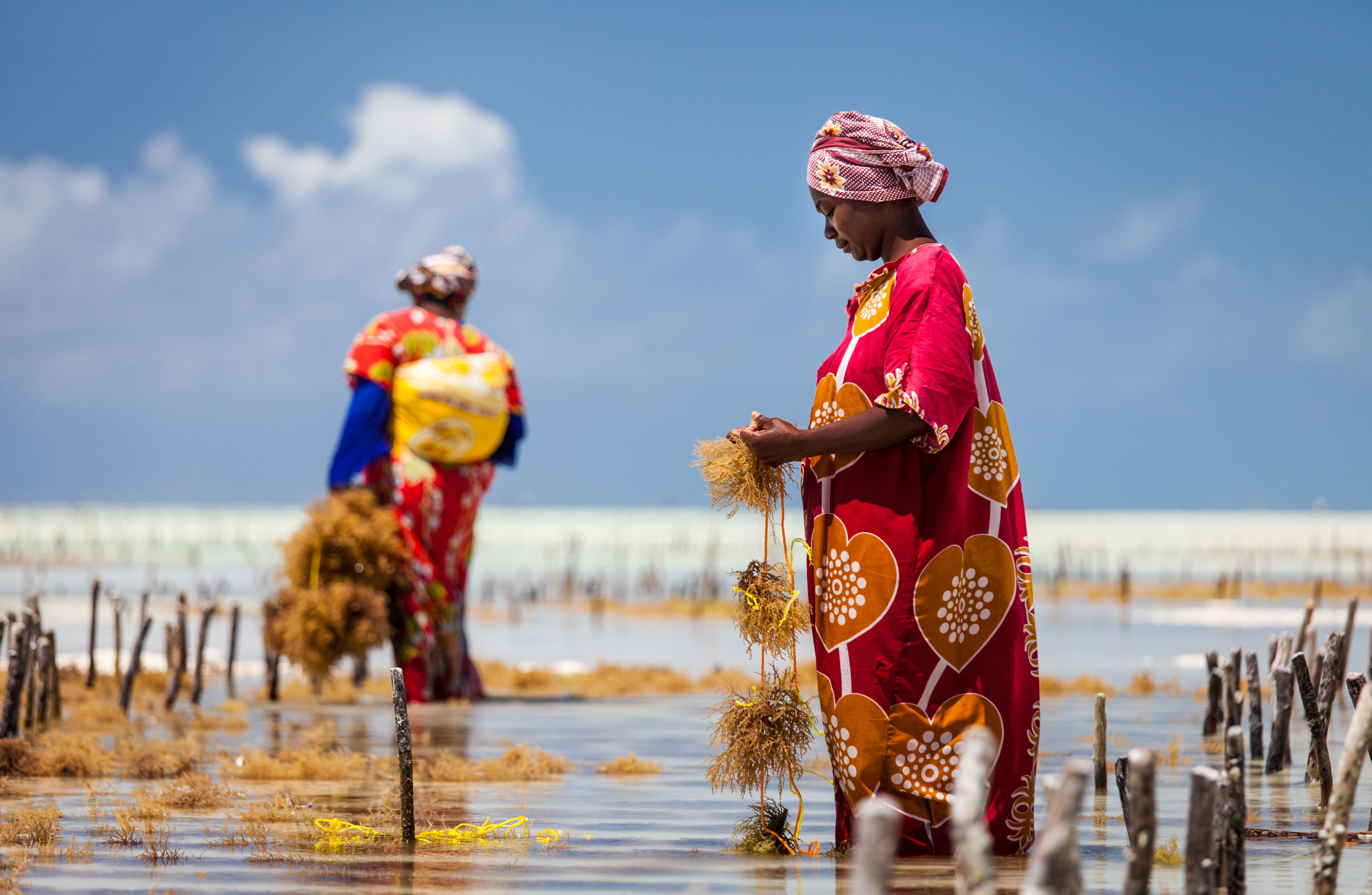
Seaweed-fiber papermaking begins well before the vat. The quality of the finished sheet depends almost entirely on how the raw algae is gathered, cleaned and broken down. This article covers the preparation steps specific to brown and red macroalgae — the two groups most commonly used in Italian coastal studios.
Species Selection
Not every marine alga produces a fiber useful in papermaking. The relevant distinction is between structural polysaccharides — primarily cellulose and hemicellulose in the cell walls — and gel-forming compounds such as alginic acid in brown algae or carrageenan in red algae.
Brown macroalgae of the order Laminariales (Laminaria digitata, Laminaria hyperborea, Ecklonia maxima) contain elongated cells with measurable cellulose content in the stipe and blade. The stipe tissue, which is denser and more fibrous than the blade, yields the most usable fiber per unit of dry weight.
Red algae such as Chondrus crispus (Irish moss) and Gigartina stellata are lower in cellulose but release carrageenan when boiled — a mucilaginous compound that acts as a natural internal size and formation aid when added to the vat.
On Italian coasts, detached Posidonia oceanica leaf litter is also collected from storm windrows. Although Posidonia is technically a seagrass rather than an alga, its dried leaf blades contain a usable cellulose fraction and have been incorporated into Amalfitan paper sheets since at least the mid-20th century.
Collection and Handling
Fresh-stranded algae is preferable to attached, still-growing material. Detached material has already lost turgor and dries more evenly. In Italy, collection from public beaches is generally unrestricted for quantities under a few kilograms per day, but local municipal ordinances vary — particularly in protected marine areas around Sicily and Sardinia.
Rinsing for Salt Removal
Salt is the primary contaminant. If not removed, residual sodium chloride draws moisture from the finished paper and causes sheets to stay soft indefinitely in humid environments. The standard rinsing protocol used by craft studios involves:
- Submerge raw algae in a large container of fresh water for 30 minutes.
- Agitate and drain. Repeat twice.
- Spread the algae thinly on a mesh drying rack and allow to sun-dry for one to two days.
- Store dry in paper sacks — not plastic, which traps moisture.
Triple-rinsed and dried algae can be stored for six to twelve months without significant fiber degradation.
Retting
Before beating, dried algae must be re-hydrated. The cell walls of brown algae do not absorb water as quickly as cotton linter — a 24-hour cold soak is the minimum for stipe material, and 48 to 72 hours is preferable for dense holdfast tissue. Retting water does not need to be treated, but very hard water with high calcium content can interfere with the gel-forming polysaccharides.
Some practitioners add a small amount of soda ash (sodium carbonate) to the retting bath — roughly 5 g per litre — to partially break down the cuticle layer and expose inner fiber cells. This shortens beating time but can reduce the mucilage content of the slurry, which affects drainage in the vat.
Beating
The objective of beating is to separate the algae tissue into individual fibers or fiber bundles and to cause surface fibrillation — microscopic hairlike projections that improve inter-fiber bonding in the finished sheet.
Hollander Beater
A Hollander beater is the most efficient tool for batch quantities above two kilograms of dry weight. Algae stipe material typically requires 20 to 40 minutes of beating at moderate bar pressure. Blade distance should be opened wider than for cotton pulp — the gelatinous matrix surrounding algae fibers cushions the roll and requires less aggressive settings to avoid cutting rather than fibrillating.
Hand Beating
For small quantities, re-hydrated algae is beaten on a stone or wooden surface with a wooden mallet. The material is folded and beaten repeatedly until it forms a cohesive, stringy mass. This approach is labour-intensive but gives the maker direct tactile feedback on fiber consistency.
Target Consistency
Well-beaten algae pulp should show visible fiber strands of 3 to 8 mm and a slightly translucent, viscous appearance when held up to light in a small amount of water. If the slurry looks opaque and granular, it is under-beaten. If it has lost visible fiber structure entirely and looks uniform and gel-like, it has been over-beaten — the fibers will not form a stable interlocked sheet.
Blending with Cotton or Linen
Pure algae sheets are fragile unless the species used has a high cellulose fraction. Most practitioners blend algae pulp with cotton linter or linen rag at ratios of 20–50% algae by dry weight. The cotton provides tensile strength and stable sheet formation; the algae contributes visual texture, slight translucency, and — in the case of carrageenan-rich red algae — natural internal sizing.
The blend ratio is adjusted depending on the intended use of the finished paper: a higher algae fraction (40–50%) produces soft, textured sheets suitable for artistic applications; a lower fraction (20–30%) yields a more dimensionally stable sheet closer to traditional Western handmade paper.
"The mucilage is not an impurity to be removed. It is a functional component — the algae's own formation aid." — Workshop notes, Atelier Carta Mediterranea, Amalfi
References
For further context on algae fiber chemistry, refer to publicly available research via Wikimedia Commons papermaking category and the technical library of the International Association of Hand Papermakers and Paper Artists (IAPMA).